
What Are the Types of Collagen and What Are Their Characteristics?
This protein is frequently used in the health and cosmetics industries after undergoing various processing methods. (1) The structures of these collagen types, and consequently their areas of use, differ from one another.
Collagen types consist of protein forms found in the connective tissues of animals and humans. Accounting for approximately 30% of all proteins in the human body, collagen plays a critical role in the structure of bones, skin, tendons, cartilage, and other connective tissues. (1) Collagen is a family of proteins consisting of different types, each with its own distinct characteristics. In general terms, it is a substance that provides structural support to bone and cartilage tissue. (2)
Different collagen types perform different functions in the body. Insufficient intake of collagen types 1, 2, and 3 may be associated with certain joint disorders. For example, studies have demonstrated the importance of type 2 collagen in the treatment of osteoarthritis, also known as degenerative joint disease. (3) In this regard, particularly individuals over a certain age, athletes, and people experiencing joint problems may, under the supervision of a healthcare professional, consider collagen-containing supplements to support healthy joint function.
What Is Type 1 Collagen? Where Is It Found?
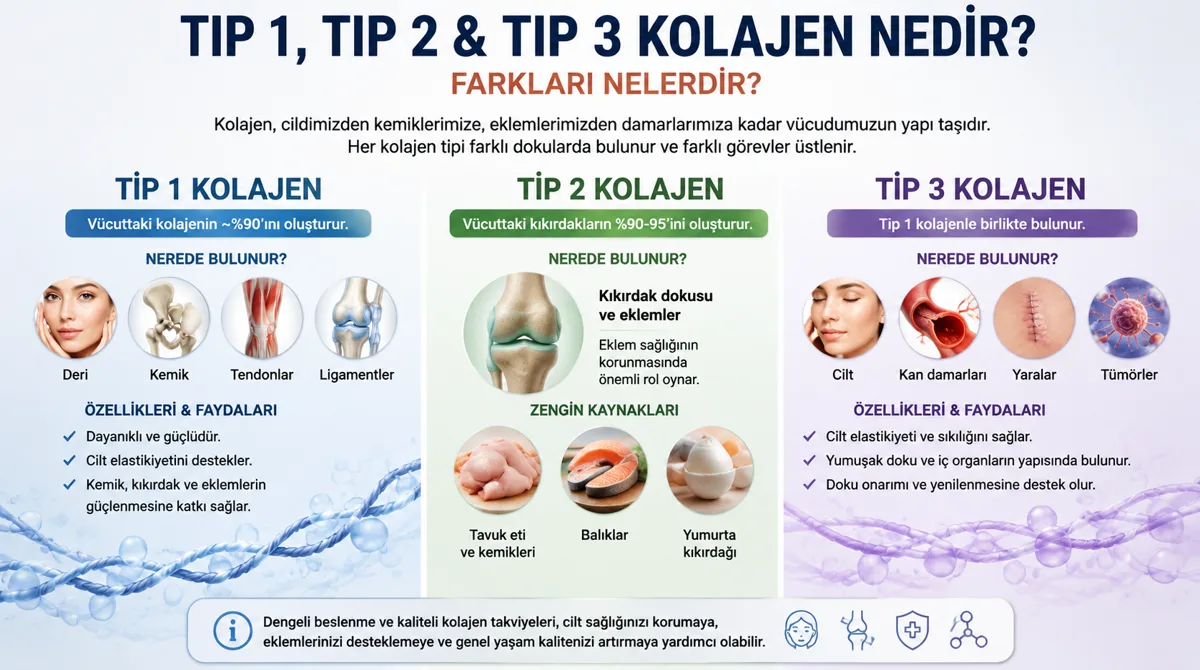
Questions such as what the different collagen types are and where they are found are among the most frequently asked questions about this type of protein. Type 1 collagen is one of the primary types to consider. Type 1 collagen accounts for approximately 90% of all collagen in the body. (4) The main areas where this type of collagen is found include:
- Skin
- Bones
- Tendons
- Ligaments (1)
This type of collagen is also found in cartilage and eye tissue. In addition, it is present in scar tissue. (2) Together with type 3 collagen, it plays an important role in wound healing. This type of collagen stands out due to its strong and durable structure. (1) Therefore, it makes a major contribution to maintaining the strength of bones, cartilage, and joints. (4)
What Is Type 2 Collagen and Which Foods Contain It?
Type 2 collagen is predominantly found in cartilage. (4) In fact, it accounts for approximately 90–95% of the total protein content of cartilage. (1) It may also be used as a supportive component in the management of joint disorders. (3) Type 2 collagen may provide support in the management of joint conditions such as osteoarthritis and rheumatoid arthritis, which can negatively affect quality of life. (1)
Among the richest sources of type 2 collagen are chicken meat and bones. This protein is primarily obtained from the joints in the rib cage of chickens. Fish are also rich sources of type 2 collagen. (3)
What Is Type 3 Collagen? Where Is It Found?
Type 3 collagen is one of the major types of collagen found in the human body. It has a fibrous structure and is a fundamental component of the complex tissue between cells. This type of protein is generally found together with type 1 collagen, and one of its primary functions is to contribute to skin elasticity and firmness. (1) It is found in various organs as well as blood vessels, wounds, and tumors. (4) Since type 3 collagen is generally found in the structure of soft tissues and internal organs, it is particularly important for maintaining and supporting the healthy condition and repair of the skin, cartilage, and connective tissue. (5) Fibrillar collagens, the class to which this type belongs, are found predominantly in animal-derived foods such as beef. (4)
References
- https://dergipark.org.tr/en/download/article-file/687493
- https://dergipark.org.tr/en/download/article-file/1186385
- https://www.ncbi.nlm.nih.gov/pmc/articles/PMC7222752/pdf/animals-10-00697.pdf
- https://acikerisim.erbakan.edu.tr/xmlui/bitstream/handle/20.500.12452/8258/CENNET%20AVCI.pdf?sequence=1&isAllowed=y
- https://www.ncbi.nlm.nih.gov/pmc/articles/PMC6579750/pdf/nihms-1529799.pdf